
A More Competitive MedTech Landscape in the EU? What the MDR/IVDR Revision Could Mean for MedTech Manufacturers and Investors
The EU’s targeted revision of the medical device and in vitro diagnostics framework has entered a more active phase, with nearly 800 amendments tabled in Parliament in July 2026 and the Council’s examination continuing in parallel. The revision would ease certification bottlenecks by removing the five-year cap on certificate validity, scaling notified body involvement to device risk, and letting lower-risk software move down to self-certified Class I. It would also loosen clinical evidence requirements, create fast-track pathways for orphan and breakthrough devices, and regulate AI-enabled devices primarily under the MDR/IVDR rather than the AI Act. This post summarizes the key aspects of the proposed revision, the prospects for their adoption, the issues still in play, and what manufacturers and investors should plan for.
The Medical Devices Regulation (MDR) and the In Vitro Diagnostic Medical Devices Regulation (IVDR), adopted in 2017 and applicable since 26 May 2021 and 2022, respectively, were designed to strengthen safety, clinical evidence, and transparency. In practice, however, the implementation of the framework has created significant compliance challenges for MedTech companies. For industry, burdensome rules, regulatory uncertainty, and notified body bottlenecks remain the biggest challenges, impacting small and medium enterprises (SMEs) in particular. Against this background, in December 2025, the European Commission (Commission) adopted a proposal for a targeted revision of the MDR/IVDR framework that would make the EU a more accessible and competitive market.
This blog summarizes the key aspects of the proposed revision, the prospects for their adoption, and what MedTech manufacturers and investors should plan for.
- Key aspects of the Commission’s proposed reform
The Commission’s proposal aims to simplify the MDR/IVDR framework, improve the predictability of certification, reduce compliance costs, and strengthen the competitiveness of the EU MedTech sector. Although the core simplification measures enjoy broad political support and are expected to survive, the European Parliament (Parliament) tabled nearly 800 amendments in July 2026, underscoring both the appetite for reform and a number of issues still in play. Within the Parliament, the tabled amendments broadly endorse aspects such as risk-based conformity assessment and software classification, while reflecting differing views on higher-risk certificates, clinical equivalence, single-use devices, and the interaction with the AI Act. The key elements of the Commission’s proposal, and, where relevant, the Parliament’s tabled amendments, are outlined below.
- Certificate validity: The Commission proposes removing the current five-year maximum validity for notified body certificates. Certificates would remain valid indefinitely, with notified bodies conducting periodic reviews proportionate to the device’s risk class. Parliamentary amendments largely preserve the proposal, although several amendments propose retaining fixed validity periods (e.g., for orphan and breakthrough devices) or enhanced reassessment for certain higher-risk or special categories; other amendments would cap certificate validity at 10 years for the highest risk implantable devices.
- Conformity assessment: To reduce bottlenecks and certification timelines, the Commission’s proposal would reduce the involvement of notified bodies in the conformity assessment of lower and medium-risk devices, making it proportionate to the device’s risk class. The Parliament generally supports a more risk-based and less duplicative conformity-assessment process.
- Software classification: The Commission proposes a substantial rewrite of MDR Rule 11. Under the proposed rule, software that generates an output conferring a clinical benefit would start from Class I, subject to a Class-upgrade depending on the seriousness of the clinical situation and the use of the output. Importantly, this would allow lower-risk software currently classified as Class IIa to move to Class I and be self-certified. Amendments tabled in Parliament broadly retain the proposal with some refinement to the criteria separating the different risk classes.
- Clinical evidence: To make the conditions for claiming equivalence more flexible, the requirement for a contract with the equivalent device manufacturer would be removed, making it easier to rely on equivalence claims. Greater use of non-clinical data for demonstrating the safety and performance of devices, including in silico testing and New Approach Methodologies, would be permitted. Parliament appears more cautious, with several amendments calling for stronger safeguards for higher-risk devices.
- Innovation pathways: The Commission’s proposal introduces a new dedicated pathway for orphan devices and breakthrough devices (BtX), which would include prioritized conformity assessment, where appropriate through rolling review, and expert-panel scientific advice. National and EU regulatory sandboxes would also be introduced. Parliamentary amendments are generally supportive of these pathways, even proposing to expand their scope. In particular, certain amendments would enable pediatric devices to benefit from the same prioritised conformity assessment and rolling-review arrangements.
- Single-use devices: The Commission proposes that manufacturers would have to justify a single-use designation, while devices not designated as single-use could be reprocessed. A person who fully refurbishes a single-use device would be treated as its manufacturer, and these rules would apply five years after entry into force. This proposal is among the revision’s most politically significant and contested elements. Parliament is divided on the issue: some amendments support greater manufacturer flexibility and hospital choice, while others oppose the justification requirement because of the burden it may create and potential patient safety concerns.
- AI-enabled devices: AI-enabled medical devices are currently subject to both the AI Act and the MDR/IVDR, creating overlapping requirements. The Digital Omnibus on AI postponed the AI Act’s high-risk obligations for devices to 2 August 2028, but kept the MDR/IVDR in Section A of Annex I. The Commission separately proposes, as part of the MDR/IVDR revision, to move the MDR/IVDR to Section B of Annex I, so that AI-enabled devices would be regulated primarily through the MDR/IVDR. Industry’s request to lawmakers to make good on their simplification, innovation and competitiveness promises by moving the MDR/IVDR to Section B was renewed as recently as October 2026 in a joint healthcare industry statement.
A similar move was proposed by the Parliament during the legislative process for the Digital Omnibus on AI, but it was not retained in the final text, thus the MDR/IVDR remained in Section A, with the relevant high-risk AI requirements applying from 2 August 2028 (for further analysis, see our earlier blog posts here and here).
The move of the MDR/IVDR from Section A to Section B is still part of the MDR/IVDR revision; it seems to enjoy broad support from industry as well as several Member States. However, the diverging positions evidenced by the Digital Omnibus process and the Parliament’s tabled amendments suggest that consensus remains elusive.
- Governance: The Commission’s proposal strengthens the coordination mechanism for determining whether a product qualifies as a medical device. The Parliament’s tabled amendments retain these provisions while proposing, among other things, additional safeguards for products already CE marked, including requiring substantiated evidence before their regulatory status may be reconsidered, and limiting reassessment to cases involving an unacceptable risk. Another amendment would establish a dedicated patient advisory group within the MDCG, modeled on EMA’s Patients’ and Consumers’ Working Party.
- Digitalization and burden reduction: The Commission’s proposal would simplify the requirements for the person responsible for regulatory compliance (PRRC), enable digital technical documentation, permit electronic instructions for use for near-patient tests, extend reporting timelines to 30 days for non-critical serious incidents, and expand e-labelling.
- International cooperation: The Commission proposes that international cooperation be strengthened through the International Medical Device Regulators Forum (IMDRF) and the Medical Device Single Audit Program (MDSAP), together with new reliance mechanisms with third-country regulators. Parliamentary amendments generally reinforce this direction, proposing greater reliance on internationally recognised certifications, and seeking greater use of assessments already carried out by trusted regulatory partners.
- Where the legislative process stands and what happens next
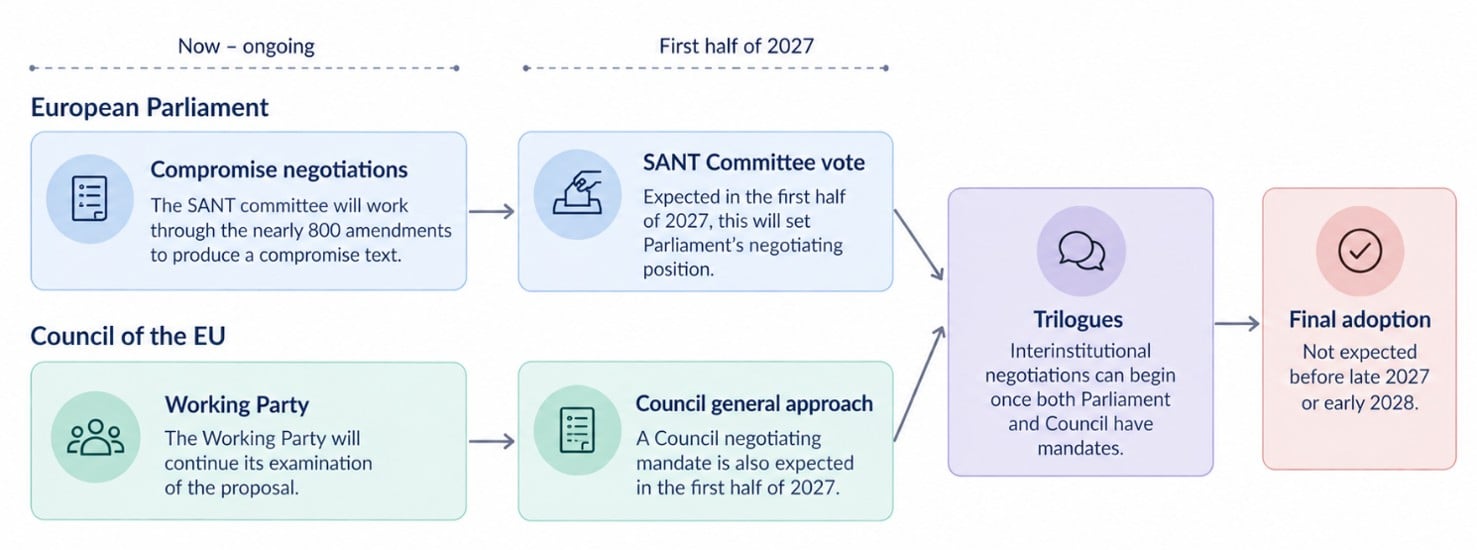
In June 2026, the Parliament Rapporteur published its draft report, and in July 2026, the deadline for tabled amendments expired. The Parliament SANT Committee is now working towards a compromise ahead of a vote expected to take place early 2027.
In parallel, the Council continues its examination with the Member States, broadly supporting the proposal’s objectives although several areas remain open. These include governance of the MDR/IVDR framework, notified body oversight, the combined impact of certain proposed simplifications, international reliance, and the interaction with the AI Act and cybersecurity legislation.
Trilogue negotiations are expected to start only in H1 2027 with a final text not likely until late 2027 or early 2028.
- MDR and IVDR are not moving in lockstep
Although the MDR and IVDR are being amended through a single legislative proposal, the parliamentary debate is playing out differently for each. Most of the political attention has centred on MDR-specific issues such as single-use devices, innovation pathways, and conformity assessment reform. But the IVDR is far from neglected; several amendments tabled in Parliament are specific to the IVDR. These include changes to conformity assessment and performance studies, including combined studies and companion diagnostics. Another amendment would introduce a new definition of “orphan IVD device,” defined as a device intended to provide information about a disease or condition affecting a maximum of five in 10,000 individuals per year within the Union. The proposed definition would also require either insufficient available alternatives or an expected clinical benefit compared with those alternatives or the state of the art.
- How MedTech manufacturers and investors can prepare for the revised framework
The early bird catches the worm. But even positive changes take time to implement, and simplification still requires planning. Manufacturers can already plan around changes that have attracted broader support, while scenario-planning for more contested measures and their potential effects on product lifecycle strategies and compliance processes. For investors, the reform may (positively) influence the attractiveness of EU market investments and the valuations of MedTech companies positioned to benefit from a simplified regulatory framework. Moreover, the proposed reform represents an opportunity to prioritise EU market investment and EU-first launch strategies, as a simplified and more predictable framework should reduce time-to-market. In particular:
- For software portfolios, the proposed Rule 11 changes could affect existing classifications, particularly for products currently classified as Class IIa. A classification would significantly reduce cost and time-to-market.
- Companies active in the companion diagnostics space could benefit from the IVDR-specific amendments, including the proposals on performance studies and combined studies, which may affect development and approval timelines.
- For manufacturers developing BtX, the EMA’s pilot program already offers early access to expert-panel support ahead of the formal legislative framework. The pilot tests key elements of the proposed BtX pathway by allowing manufacturers to seek an opinion on breakthrough status and, for designated devices, advice on development and evidence-generation. The pilot is currently open to manufacturers whose devices have been recognized as BtX, who may now request scientific advice from the expert panels. Participation is limited to Class III devices and Class IIb active devices intended to administer or remove a medicinal product from the body. Engaging early with the pilot may help shape regulatory strategies and shorten the path to market once the new BtX pathway is adopted.
- Investors should assess how the proposed simplifications, including shorter certification timelines, greater flexibility on equivalence, and more proportionate conformity assessment, could affect regulatory risk and time-to-market projections for MedTech companies with EU exposure.
- Looking Ahead
The revision is still at committee and Working Party stage. The next milestones are:
The proposal provides for general application six months after entry into force, with different application dates for certain provisions, including 12 months for the new notified body designation and monitoring rules, and five years for the new rules on single-use devices and reprocessing.
The blog was authored by Josefine Sommer, Michelle Gandolfo, and Belinda Baum.
This post is as of the posting date stated above. Sidley Austin LLP assumes no duty to update this post or post about any subsequent developments having a bearing on this post.
Contacts
https://goodlifesci.sidley.com/wp-content/uploads/sites/6/2022/03/sidleyLogo-e1643922598198.png 0 0 Josefine Sommer https://goodlifesci.sidley.com/wp-content/uploads/sites/6/2022/03/sidleyLogo-e1643922598198.png Josefine Sommer2026-10-16 03:03:292026-10-16 12:30:47A More Competitive MedTech Landscape in the EU? What the MDR/IVDR Revision Could Mean for MedTech Manufacturers and Investors






You might also like
 2025 to First-Half 2026 Marks a Breakout Time for CVRs